


Table of Contents
- Why Flour Tortillas Need a Different Kind of Tortilla Press
- Cast Iron vs Aluminum Tortilla Press: Which Material Works Better
- Key Features to Compare Before You Buy
- How to Make Flour Tortillas at Home with a Press
- Pressing Technique and Troubleshooting Sticking and Spring-Back
- Large and Burrito-Size Tortillas: What to Look For
- Total Cost, Durability, and Long-Term Ownership
- Frequently Asked Questions
Last Updated: October 21, 2026
Why Flour Tortillas Need a Different Kind of Tortilla Press
A tortilla press is a hinged tool that flattens dough into a round disc between two flat plates. Most presses are built for corn masa, which matters if you plan to make flour tortillas at home.
The core problem: corn masa is crumbly and holds its shape when compressed, while flour dough is elastic.
That does not mean skipping the press, it means knowing which features matter for flour and which are marketing noise.
Cast Iron vs Aluminum Tortilla Press: Which Material Works Better
Cast iron wins on pressure; aluminum wins on convenience. Your choice depends on how often you cook and how much counter space you can spare.
Cast iron presses are heavy, often 4 to 8 pounds, and that weight does part of the flattening work for you, which matters with elastic flour dough.
Aluminum presses are light, often under 2 pounds, and resist rust. Our Aluminum Alloy Home Tortilla Maker comes in two sizes, 16cm and 20cm, and two colors, silver and black, at weights of 0.375kg and 0.63kg.

| Material | Pressure | Weight | Maintenance | Best For |
|---|---|---|---|---|
| Cast iron | High, weight-assisted | Heavy | Dry and oil after washing | Frequent bakers, thick flour tortillas |
| Aluminum | Moderate, manual | Light | Wipe and dry | Small kitchens, occasional use |
| Hardwood | Low to moderate | Medium | Oil occasionally, no soaking | Display and light use |
| Steel | Moderate | Medium | Dry promptly, watch for rust | Budget buyers |
If you make tortillas twice a month, aluminum is the smarter purchase.
Key Features to Compare Before You Buy
Ignore the packaging claims and check four things: plate diameter, hinge behavior, handle comfort, and how the plates meet.
Plate Diameter and Tortilla Size
Plate diameter sets your ceiling on tortilla size. An 8-inch press yields roughly 6-inch tortillas after the dough pulls back, plenty for taco size. For burritos you need more room, covered below.
Hinge, Handle, and Even Pressure
A good hinge moves smoothly without wobble. Grab the top plate and rock it gently; side-to-side play means uneven pressing, one thick edge, one torn edge. The handle should sit comfortably in your palm, because with flour dough you will press harder than you expect.
How to Make Flour Tortillas at Home with a Press
Learning how to make flour tortillas at home with a press comes down to dough rest and lining. Rest the dough, line the plates, press once, and cook on a hot dry skillet.
- Mix and rest. Combine flour, fat, salt, and warm water into a soft dough. Cover and rest it at least 30 minutes so the gluten relaxes.
- Portion. Roll balls slightly smaller than your press plate. A ball that is too big buckles the edges.
- Line both plates. Place the dough ball between two sheets of parchment paper or a cut plastic liner.
- Press once, firmly. Lower the top plate and press evenly. Do not pump the handle.
- Peel, do not pull. Lift the top liner away slowly, then slide your hand under the tortilla.
- Cook hot and fast. A dry skillet over medium-high heat, roughly 30 to 45 seconds per side, until bubbles form and brown spots appear.
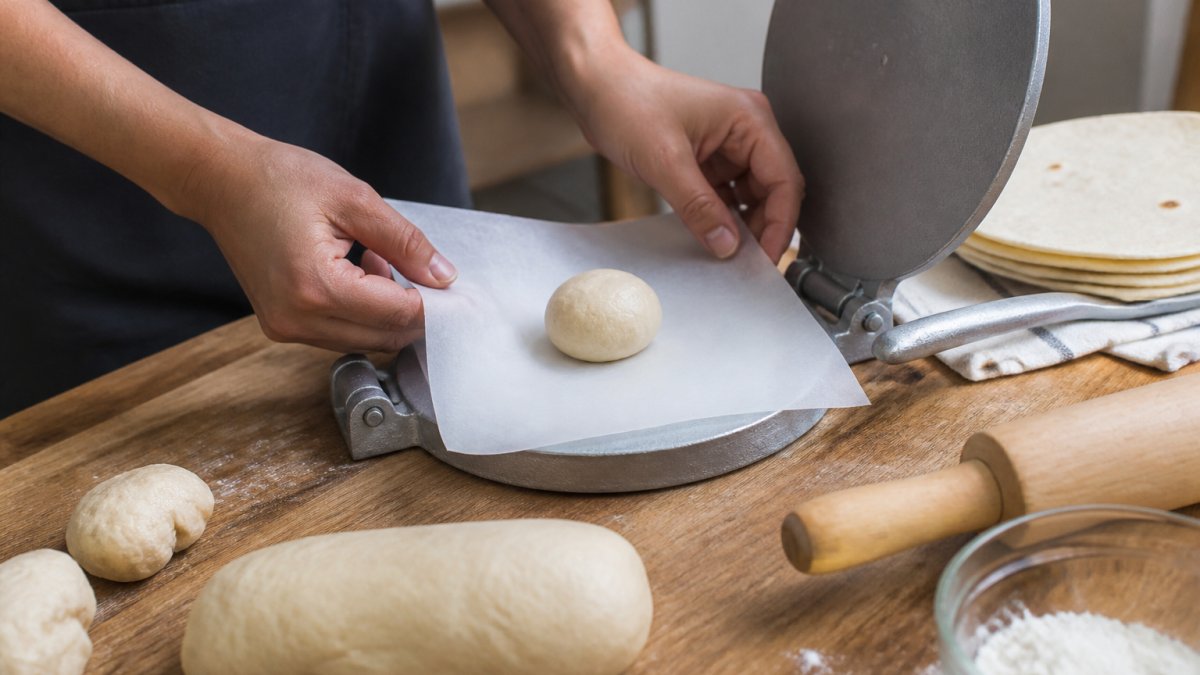
The rest step is the one people skip. Unrested dough springs back every time, no matter how good your press is.
Pressing Technique and Troubleshooting Sticking and Spring-Back
Sticking and spring-back are the two failures that send presses to the back of the cabinet. Both are dough-and-technique problems more than press problems, and both have concrete fixes.
Diagnose Before You Adjust
Before changing anything, press one test ball and watch what happens. The failure mode tells you which variable to change:
- Shrinks back immediately after lifting the plate → gluten is tight or dough is too stiff. Rest longer or add water.
- Sticks to the top plate and tears → missing liner, dough too wet, or plate is cold and tacky.
- One thick edge, one thin edge → uneven pressure or an off-center ball. Re-center and press with two hands over the hinge.
Fixing Sticking
Sticking almost always comes down to the liner. How the common options compare:
| Liner | Release | Reusable | Notes |
|---|---|---|---|
| Parchment paper | Excellent | 3-5 presses per sheet | Cut circles slightly larger than the plate; creases transfer to the tortilla |
| Cut plastic bag (freezer weight) | Excellent | Dozens of presses | Best release for wet dough; wipe clean between balls |
| Silicone mat | Good | Indefinite | Thicker, so it slightly reduces effective plate pressure |
| Bare plate, light flour | Poor to fair | n/a | Only works with a stiff, well-rested dough; risks dry cracking |
| Bare plate, light oil | Fair | n/a | Can make flour dough slippery and uneven; not recommended |
A light dusting of flour on the liner helps release, but too much creates a dry, cracked surface that will not brown evenly.
Fixing Spring-Back
Spring-back is a gluten problem. Three causes dominate, each with a specific correction:
- Under-rested dough. Flour dough needs at least 30 minutes covered at room temperature, and 45-60 minutes is better for higher-protein all-purpose flour. Rest in a lightly oiled bowl so the surface does not dry.
- Too stiff a dough. Add water a tablespoon at a time until the dough feels soft and slightly tacky, like a soft earlobe, not like bread dough. A dry dough will fight the press no matter how hard you lean.
- Cold dough. Balls straight from the fridge are tight and springy. Let them sit 20-30 minutes on the counter before pressing.
Pressing repeatedly makes spring-back worse because each pass re-tensions the gluten. One firm, steady press beats three hesitant ones.
Pressure Sequencing That Works for Flour
Flour dough responds best to a short, firm press, not a slow squeeze:
Aluminum Alloy Home Tortilla Maker →
- Set the lined ball just behind the plate center, flour dough drifts forward as it flattens.
- Lower the top plate until it just touches the dough.
- Press down over the hinge with both palms, using body weight, for a count of two.
- Release immediately. Do not hold pressure or pump the handle.
- Lift the top liner slowly from one edge; if it resists, the dough is too warm or too wet.
A rolling pin still has a place: many cooks finish a pressed flour tortilla with two or three light passes to reach full thickness and roundness. The press does the heavy flattening; the pin does the fine tuning. If your press has a loose hinge, skip the pin, the wobble will produce an oval.
Large and Burrito-Size Tortillas: What to Look For
Burrito-size flour tortillas run 10 to 12 inches across, beyond most home presses. The mismatch between the common 8-inch plate and the burrito-size tortilla readers want is the biggest source of disappointment with flour-tortilla presses.
Plate Diameter vs. Finished Tortilla Size
Flour dough pulls back after pressing, so the finished tortilla is always smaller than the plate, roughly 15-25% depending on hydration and rest. Use this as a planning guide:
| Plate diameter | Realistic finished size | Best for |
|---|---|---|
| 6 inch | 4.5-5 inch | Snack and appetizer tortillas |
| 8 inch | 6-7 inch | Taco and fajita size |
| 10 inch | 7.5-8.5 inch | Large taco, quesadilla, small burrito |
| 12 inch | 9-10 inch | Burrito-size, with a pin finish |
| 14 inch+ | 11-12 inch | Full burrito-size, specialty presses only |
Measure the plate, not the handle-to-handle length printed on the box. A "10-inch press" in marketing copy often means a 9-inch plate.
Why Bigger Plates Are Harder Than They Look
A larger top plate needs more force to flatten elastic dough evenly. Two things make that manageable:
- Mass. A heavy top plate (cast iron or thick steel) does part of the work for you. A lightweight aluminum plate at 12 inches will flex unless the hinge is very firm.
- Leverage. A longer handle gives more mechanical advantage, but only if the hinge is tight. A long handle on a wobbly pivot produces an oval, not a circle.
Before buying a large press, open and close it one-handed. If the top plate rocks side to side, it will not press a 10-inch flour tortilla evenly.
The Two-Step Method for Burrito-Size Tortillas
For anything above 10 inches, the practical answer is a combination: press the dough to about 8 inches, then finish with a rolling pin.
- Press first. The press does the heavy, even initial flattening, it removes the thick center a pin tends to leave.
- Rest 30 seconds. Let the gluten relax briefly so the pin does not fight it.
- Roll outward from the center. Two or three light passes, rotating the disc a quarter turn between passes, gets you to 10-12 inches with a round edge.
- Cook immediately. A larger, thinner tortilla dries out fast; do not stack uncooked discs.
Our 20cm aluminum model handles the initial flattening well, and the pin takes it the rest of the way. That two-step method gives you round, even burrito-size tortillas without a specialty press.
When to Skip the Press Entirely
For tortillas above 12 inches, a rolling pin alone is often faster than fighting a press. Presses earn their place up to about 10 inches; beyond that, a pin gives more control over roundness and thickness.
Total Cost, Durability, and Long-Term Ownership
Total cost is more than the sticker price. A press that rusts in six months costs more than one that lasts a decade, even at double the price.
Aluminum models resist rust and need almost no upkeep. Cast iron needs drying and oiling after every wash, and skipping that routine is how most cast iron presses end up pitted.
Storage counts too. A heavy press that lives on the counter gets used; one hauled out of a low cabinet does not.
Our Aluminum Alloy Home Tortilla Maker costs $24.10, comes in 16cm and 20cm sizes, and weighs as little as 0.375kg.
Frequently Asked Questions
Do tortilla presses work for flour tortillas?
They can, but flour dough is more elastic than masa and tends to spring back after pressing. A press flattens the dough quickly, then the gluten pulls it inward again. To get consistent results with a tortilla press, rest the dough 20 to 30 minutes first, press gently rather than forcing the handle down, and finish with a rolling pin if you need a thinner round. Cast iron and heavier aluminum presses hold pressure more evenly, which helps.
Why do flour tortillas shrink back when pressed?
Shrink-back comes from gluten tension. When you roll or press flour dough, the gluten network stretches and then contracts once the pressure is released. Resting the dough lets the gluten relax, so the round holds its size. Warm dough also stretches more easily than cold dough. If your tortillas keep pulling inward, cover the dough and wait 15 to 20 more minutes before pressing again.
What size tortilla press is best for burritos?
Burrito-size flour tortillas usually run 10 to 12 inches across, so you need a press with a plate diameter close to that, or you press a smaller round and finish it with a rolling pin. Most home presses have 6- to 8-inch plates, which suit tacos and quesadillas. For larger tortillas, check the plate diameter before buying and plan on a short roll-out step after pressing.
How do you prevent flour tortillas from sticking to a press?
Line both plates with parchment paper or a cut plastic bag before pressing. Flour dough is damp and sticky, and bare metal or cast iron will grab it. A light dusting of flour on the dough ball helps, but too much flour makes the tortilla dry and stiff. If you press without a liner, clean and dry the plates between tortillas so buildup does not tear the next one.
Making tortillas from scratch asks for a tool that matches your dough, your counter, and your routine. A press built for elastic flour dough, paired with a proper rest and a parchment liner, removes most of the frustration. Browse the Aluminum Alloy Home Tortilla Maker in both sizes and colors, pick the plate diameter that fits the tortillas you actually eat, and add it to your cart.


