


Table of Contents
- Best Portable Travel Gadgets for Organized Packing: Quick Comparison
- How We Evaluated These Travel Gadgets
- Portable Packing Cubes and Compression Organizers
- Travel Toiletry Organizer: Keeping Liquids and Essentials Contained
- Best Travel Bag for Organization: Choosing the Right Carry-On
- Electronics and Cable Organization for Stress-Free Travel
- Security and Comfort Gadgets That Protect Valuables
- Conclusion: Packing Smarter with the Right Travel Gadgets
- Frequently Asked Questions
Last Updated: October 5, 2026
Best Portable Travel Gadgets for Organized Packing: Quick Comparison
The best portable travel gadgets for organized packing solve one problem each: they keep a category of belongings contained, compressed, charged, or protected so nothing shifts in transit.
Packing cubes are the foundation; compression versions cut bulk further. A toiletry organizer, a structured carry-on, and an electronics pouch then handle the three categories that cause the most mess.
| Gadget Category | Solves | Pack Stage | Priority |
|---|---|---|---|
| Packing cubes | Loose clothing chaos | Packing | Essential |
| Toiletry organizer | Liquid leaks and spills | Packing | Essential |
| Structured carry-on | Access and capacity | Packing | Essential |
| Cable organizer | Tangled chargers | In transit | High |
| Power bank | Dead devices | In transit | High |
| Portable door lock | Room security | At destination | Situational |
| Item tracker | Lost luggage | In transit | Situational |
Here is how we think about each category, and what to look for before you buy.
How We Evaluated These Travel Gadgets
We judge travel gadgets on five criteria: packed size, weight, durability, how fast you can find things, and whether the item works across trip types.
A gadget that saves space but adds weight fails, as does one that only works for a weekend trip. The strongest picks fold flat, wipe clean, and survive an overhead bin.
Portable Packing Cubes and Compression Organizers
Packing cubes are fabric containers that group clothing by type or day; compression cubes add a second zipper that squeezes air out.
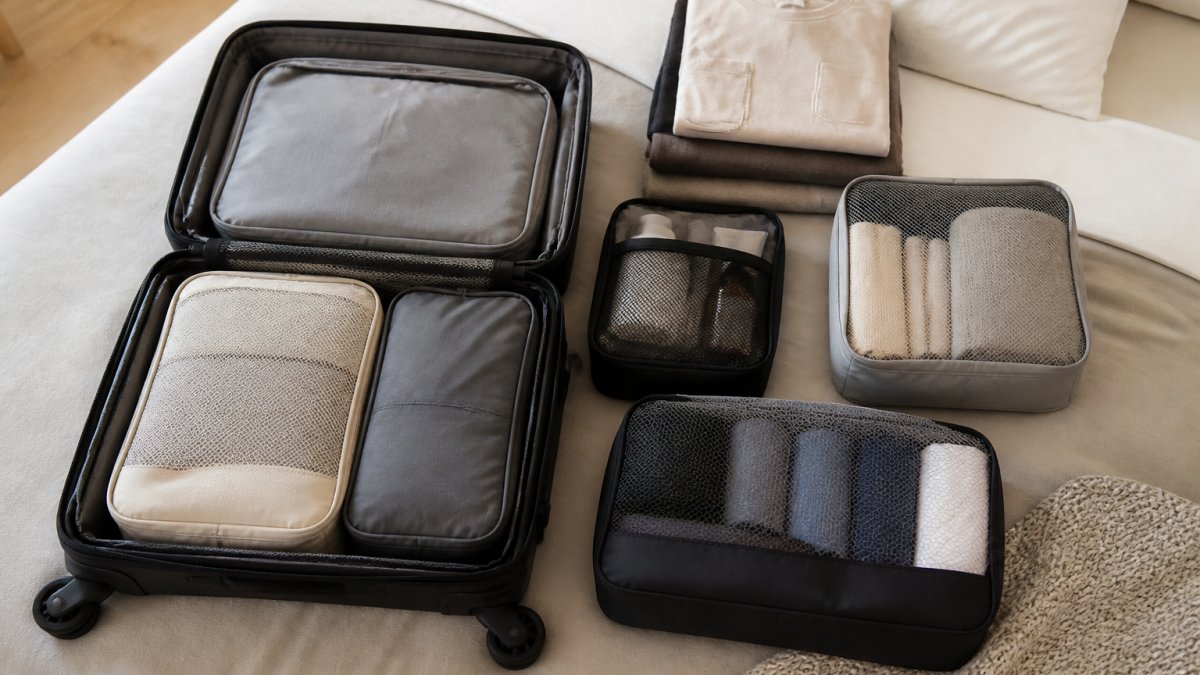
Compression vs. Standard Packing Cubes
Standard cubes organize; compression cubes organize and shrink. A compression cube typically saves enough volume for several extra garments, which matters most on long-haul trips where you pack for a week or more.
Compression cubes cost and weigh slightly more. For a two-day business trip, standard cubes are enough; for anything longer, compression earns its place.
A compression cube works by pulling a second zipper that cinches the perimeter inward, forcing trapped air out through the fabric.
A Packing System by Item Type and Trip Stage
Most guides hand you a list of cubes. A system is more useful, because organized packing is three separate jobs: getting everything into the bag, reaching what you need in transit, and unpacking without turning the room into a pile.
Stage 1, Pack (in the suitcase):
- One large cube for tops and bottoms, folded flat and stacked vertically so you can see every item.
- One medium cube for underlayers, sleepwear, or workout clothing.
- One small cube for socks and undergarments.
Stage 2, Transit (reachable without opening the main compartment):
- A small pouch for chargers, earbuds, and a power bank.
- A flat document sleeve for a passport, boarding pass, and a pen.
- A snack or medication pouch in an exterior pocket.
Stage 3, Unpack (at the destination):
- Lift the large and medium cubes out whole and set them in a drawer or on a shelf. You have unpacked in under a minute without re-folding anything.
- Move dirty items into the empty laundry cube as the trip progresses, so clean and worn clothing never mix.
This three-stage approach separates a bag that stays organized for two weeks from one that is chaos by day three.
What to Look For in Packing Cubes
- Smooth two-way zippers. Cheap zippers fail first, usually mid-trip; two-way sliders open from either end without dumping contents.
- Mesh or breathable panels. They let you see contents and reduce trapped odor.
- Reinforced seams. Compression stresses stitching; look for bar-tacked corners.
Sizing Cubes to Your Carry-On
Most domestic carry-on bags are capped around 22 x 14 x 9 inches, and the interior is smaller than the exterior once you account for wheels, handles, and a laptop sleeve.
A practical rule: measure the flat interior floor, then choose a large cube that leaves at least an inch of clearance on every side.
Travel Toiletry Organizer: Keeping Liquids and Essentials Contained
A travel toiletry organizer holds bottles, tubes, and small tools in one contained unit so spills stay inside the bag instead of soaking your clothes. It is the highest-value upgrade after packing cubes.
TSA-Friendly Sizing and Clear Pouches
Under TSA's 3-1-1 liquids rule, carry-on liquids must fit in a single quart-sized clear bag, with each container holding 3.4 ounces or less. A toiletry organizer with a removable clear pouch lets you pull the pouch out at security without unpacking the whole bag.
Check the quart capacity before buying. A pouch that is slightly too large gets rejected at the checkpoint.
Leak Protection and Easy Access
Look for a coated or water-resistant lining, not just nylon. Bottles leak from in-flight pressure changes, and a coated lining keeps that liquid off your clothing.
Best Travel Bag for Organization: Choosing the Right Carry-On
The best travel bag for organization has defined compartments: a clamshell opening, at least two internal compression straps, and separate access to a laptop sleeve. Compartments do the organizing work packing cubes cannot.
Carry-On Dimensions and Airline Restrictions
Most major airlines cap domestic carry-on bags at 22 x 14 x 9 inches, though limits vary by carrier and fare class. Measure your bag including wheels and handles, since those count.
Check your specific airline's published limits before you fly. Budget fares often enforce smaller dimensions than the main cabin.
Portable Door Lock Solid Heavy Duty Door Lock for Additional Safety →
Pockets, Elastic Loops, and Storage Capacity
Elastic loops hold pens, cables, and small tools in place. Exterior pockets give you fast access to a passport or boarding pass without opening the main compartment. A flat interior pocket keeps documents from bending.
Capacity matters less than access. A 40-liter bag you can open flat beats a 45-liter bag you have to dig through.
Electronics and Cable Organization for Stress-Free Travel
An electronics organizer is a zippered pouch with elastic loops and mesh pockets that keeps cables, adapters, and small devices separated, preventing the tangle that costs ten minutes at every hotel desk.
But the pouch is only half the job. The other half is knowing what your devices need, so you pack the right cables and chargers instead of a bag of mystery connectors.
Portable Chargers, Power Banks, and Built-In Cables
A power bank keeps your phone alive through a long connection.
Airline rules matter here. Spare lithium-ion batteries and power banks must travel in carry-on baggage, not checked bags, and most carriers enforce watt-hour limits.
Built-in cables remove one more loose item, but they cannot be replaced if they fail, so a power bank with a standard USB port plus a separate cable is the more repairable choice.
Connector Types and Charging Speed
This is where most packing guides stop short, and it is the part that saves you a dead phone at the gate.
- USB-A vs. USB-C: USB-C is now the standard on phones, tablets, and most laptops. USB-A still appears on older chargers and hotel outlets. Pack at least one cable for each port type you rely on.
- Lightning vs. USB-C: If anyone in your group uses an older iPhone, you need a Lightning cable in addition to USB-C. A single multi-tip cable can cover both, at the cost of a bulkier connector head.
- Charging speed: A cable and charger must both support the same fast-charging standard to deliver full speed. A fast-charging phone paired with a basic 5-watt charger will charge slowly no matter how good the cable is. Match the charger's wattage to the device's rating.
Travel Adapters and Charging Safety
A plug adapter changes the shape of your plug. A voltage converter changes the current. They are not the same device, and using the wrong one can damage electronics.
Check the voltage printed on each device before you plug in. Many chargers and laptops handle dual voltage (often marked 100-240V); hair tools and small appliances often do not.
A few safety habits worth packing into your routine:
- Plug a power strip or multi-port charger into the wall adapter once, then charge everything from that single point, reducing the adapters you need.
- Avoid charging on a soft surface like a bed or carpet, where heat cannot escape.
- Unplug chargers when not in use; a warm charger left overnight is a common cause of minor damage.
Security and Comfort Gadgets That Protect Valuables
Security and comfort gadgets cover two needs: keeping your room and belongings secure, and helping you sleep on a long-haul flight. Both are situational and worth packing once you have used one.
Portable Door Locks and Item Trackers
A portable door lock adds a second barrier to an existing lock and installs without tools, which suits hotel rooms, rentals, and dormitories. Our Portable Door Lock is built from solid metal alloy, fits most standard doors, and leaves no marks behind.
An item tracker goes in a checked bag or a wallet. If the bag goes missing, the tracker tells you where it is.
Sleep Masks, Ear Plugs, and Neck Pillows for Long-Haul Travel
Sleep accessories are the difference between arriving functional and arriving wrecked. A contoured sleep mask blocks light without pressing on your eyes. Foam ear plugs cut cabin noise. A neck pillow with a firm core supports your head instead of collapsing.
Pack these in an outside pocket, not the bottom of your bag, you want them before the cabin lights dim.
Conclusion: Packing Smarter with the Right Travel Gadgets
Organized packing comes down to containment: every category of belonging gets a home, and every home has a place in the bag.
Lesara's Odds & Ends stocks the small tools that make this work, from the Portable Door Lock for rental stays to pet travel gear for trips with a companion.
Add to cart and pack your next trip by category, not by chance.
Frequently Asked Questions
What is the 3-3-3 rule for travel packing?
The 3-3-3 rule is a simple packing framework: three outfits, three pairs of shoes, and three toiletry essentials for a three-day trip. It works because it forces you to pack by category rather than tossing items in randomly. Pair it with portable packing cubes to keep each set separated, and you can repack in minutes. For longer trips, scale the numbers up while keeping the same category-based system.
What is the best travel bag for organization?
The best travel bag for organization has multiple compartments, elastic loops for cables, and a dedicated shoe or laundry section. Look for a carry-on that meets standard airline size limits, usually around 22 x 14 x 9 inches, so you avoid gate-checking. A bag with a clamshell opening lets you see everything at once, and interior compression straps keep contents from shifting during long-haul travel.
Which portable organizers help keep clothes and accessories separated?
Portable packing cubes, stuff sacks, and compression organizers are the main tools for separating clothes and accessories. Use small cubes for underwear and socks, medium cubes for shirts, and a slim pouch for chargers and cables. Compression cubes reduce bulk by up to a third, which matters when you are limited to one carry-on. Label each cube by category so you never dig through the whole bag at security.
How do you keep toiletries organized in a travel bag?
Use a travel toiletry organizer with clear, TSA-friendly pouches so liquids stay visible and contained. Keep bottles under 3.4 ounces, seal them in a leak-proof bag, and store the organizer at the top of your carry-on for easy access. A hanging design lets you unpack in seconds at a hotel. Group items by function: one pouch for skincare, one for dental care, and one for medications.
What should you look for in a compact travel organizer?
Prioritize lightweight materials, durable zippers, and a size that fits inside your carry-on without wasting space. Elastic loops and mesh pockets add storage capacity without bulk. Check that the organizer is easy to clean and that any compression feature actually saves space rather than just adding straps. For security, a small organizer with a padlock loop or an item tracker pocket adds peace of mind on long-haul travel.


