


Table of Contents
- What You'll Need Before You Start Shopping
- Step 1: Match the Pillow Type to Your Sleep Position
- Step 2: Weigh Memory Foam vs Inflatable Travel Pillow Options
- Step 3: Prioritize Chin Support and Neck Alignment
- Step 4: Get the Fit Right and Learn How to Wear a Travel Neck Pillow
- Step 5: Choose a Washable Travel Neck Pillow for Hygiene
- Common Mistakes to Avoid When Buying a Travel Neck Pillow
- Conclusion
- Frequently Asked Questions
Last Updated: October 6, 2026
What You'll Need Before You Start Shopping
Two-thirds of testers in a comparative panel picked the Travelrest as their preferred travel neck pillow for comfort and neck support, according to Wirecutter's travel pillow testing panel.
A travel neck pillow is a support device that fills the gap between your neck and the headrest, keeping your head from flopping forward or sideways while you sleep upright. Get that gap wrong and you'll land with a stiff neck and a headache.
This guide covers the five decisions that actually matter.
Before you shop, know three things: your sleep position, your carry-on space, and your neck length. Everything else is secondary.
Step 1: Match the Pillow Type to Your Sleep Position
Side sleepers need lateral support, while back sleepers need a chin prop. Front slouchers need a wrap that stops the head drop entirely.
The three main designs solve different problems:
- U-shaped pillows support the sides of the neck but leave the chin unsupported, so the head can still fall forward.
- Chin-wrap designs anchor the jaw and prevent forward head drop, which matters most on red-eye flights.
- J-shaped pillows combine a chin wrap with a longer tail that tucks under the ear for side sleepers.
U-Shaped, Chin-Wrap, and J-Shaped Designs
Market reviews show a clear shift toward ergonomic, 360-degree support structures over traditional U-shaped pillows, per Solo Traveller App's travel pillow market review. The reason is simple: a U-shape only supports two sides of a three-direction problem.
The U-shape still works if you sleep leaning back. If your head tips forward the moment you drift off, skip it.
| Pillow Type | Best For | Main Weakness |
|---|---|---|
| U-shaped | Back leaners | No chin support |
| Chin-wrap | Forward head drop | Bulky to pack |
| J-shaped | Side sleepers | Fiddly to position |
Step 2: Weigh Memory Foam vs Inflatable Travel Pillow Options
Memory foam wins on support, inflatables win on packability. There is no design that does both well, so pick your priority before you compare models.
The mechanism matters more than the marketing label.
A memory foam pillow holds its shape and distributes pressure across the neck.
Inflatable pillows work on a different principle. A sealed air chamber has no memory, so it returns whatever pressure you put into it.
Packability and Durability Trade-Offs
- Memory foam: bulky, heavier, excellent support, holds shape for years if the density is adequate; degrades into a flat pancake if it isn't
- Inflatable: packs to roughly the size of a fist, very light, adjustable firmness via how much you inflate; prone to slow leaks at the valve and seam
- Hybrid (foam fill plus stuff sack): middle ground, moderate bulk, decent support, compresses further than solid foam but less than a pure inflatable
A few practical rules of thumb:
- If you fly weekly, foam earns its space. The support does not degrade trip to trip, and you avoid the valve failure that ends most inflatable lifespans.
- If you fly twice a year and pack light, inflatable is the smarter call, provided you test the valve before every trip.
- If you sleep hot, note that solid foam traps heat against the back of your neck. A ventilated foam core or a mesh cover offsets most of this.
One more check that most buyers skip: squeeze the foam and watch how fast it springs back. Fast rebound usually means low density and a short useful life. Slow, even rebound is the better sign.
Step 3: Prioritize Chin Support and Neck Alignment
Chin support is the single feature that separates a pillow you keep from one you abandon. Without it, your head drops forward the moment your neck muscles relax.
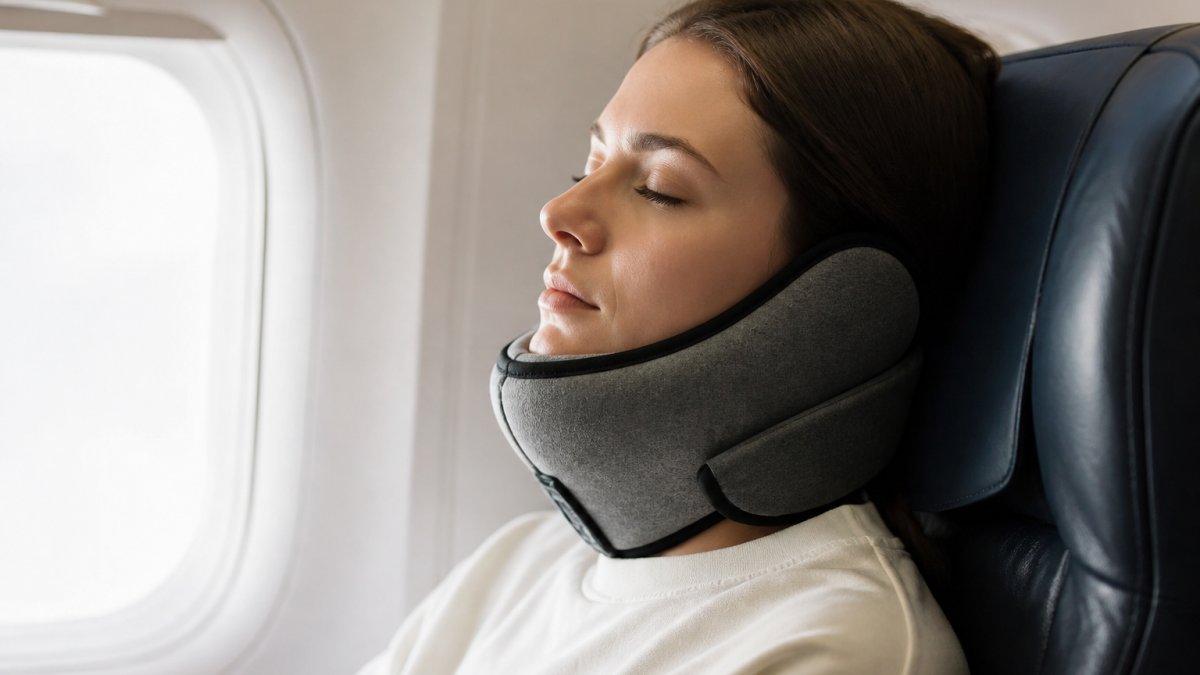
Testing panels found that designs built around 360-degree support and chin wraps measurably improved perceived comfort during simulated long-haul travel, per Wirecutter's comparative pillow testing.
Neck alignment matters just as much.
A pillow that's too thick pushes your head forward. Too thin and your neck bends sideways. The right depth keeps your ear roughly above your shoulder.
Step 4: Get the Fit Right and Learn How to Wear a Travel Neck Pillow
Most people wear a travel neck pillow wrong, and that's why it slides down mid-flight. The closure goes at the front, under your chin, not at the back of your neck.
Here's how to wear it correctly:
- Open the closure and place the pillow behind your neck
- Bring both ends forward so they meet under your chin
- Fasten the closure snugly, but not tight enough to press on your throat
- Tilt your head back until it rests against the headrest
- Adjust the side wings so your ears sit inside them
The fit test takes ten seconds. Turn your head left and right. If the pillow shifts more than a couple of inches, it's too loose.
One-size-fits-all pillows often fail taller adults and people with longer necks, since standard models don't provide adequate support for every body type, per No Sleepless Nights on pillow fit limitations.
Step 5: Choose a Washable Travel Neck Pillow for Hygiene
A washable travel neck pillow is not a luxury. It's the difference between a fresh flight and a breakout along your jawline.
Your pillow touches your face, hair, and neck for hours. It picks up cabin oils, sweat, and whatever was on the seat before you sat down. A removable, machine-washable cover solves this in one step.
What to check before buying:
- Removable cover: zips off and goes in the washing machine
- Hypoallergenic fill: reduces irritation for sensitive skin
- Breathable fabric: mesh or moisture-wicking panels cut heat buildup
- Cover material: cotton blends wash better than coated synthetics
Consumer preference is trending toward breathable and cooling materials to reduce heat buildup during long flights, per Cozy Bliss on travel comfort materials. Heat is the number two complaint after poor support, and a breathable cover fixes most of it.
Build a Sleep System, Not Just a Pillow
This is the angle most buying guides skip. A neck pillow does not work in isolation. It works as one part of a small sleep system, and the piece that pairs with it best is an eye mask.
Light is the single biggest reason people fail to sleep on a plane, and a pillow that holds your head still does nothing if cabin lights and seatback screens keep your brain awake. Pairing the two solves both problems at once:
- A contoured eye mask blocks light without pressing on your eyelids, which matters if you wear contacts or have sensitive skin.
- A strap that connects the mask to the pillow keeps both in place when you shift positions, so you are not fishing for a loose mask under your seat at hour three.
- A mask with a nose baffle reduces light leak around the bridge, which is the most common failure point of cheap masks.
Some pillows now ship with a built-in mask or a clip loop for one. If yours does not, a simple elastic strap threaded through the pillow's closure works just as well. The goal is fewer loose items to juggle at boarding and less repositioning mid-flight.
Sanitizing Routine for Long-Haul Travel
Wash the cover after every long-haul trip. Spot-clean the foam core with a damp cloth and let it air dry fully before you pack it away. Trapped moisture is what turns a foam pillow musty between trips.
A simple routine that works:
- Unzip and machine-wash the cover on a gentle cycle, then air dry.
- Wipe the foam core with a damp cloth and a drop of mild soap. Do not soak it.
- Let the core dry completely, ideally in open air, before zipping the cover back on.
- Wipe down the eye mask lens or fabric with a gentle wipe, and wash fabric masks on the same schedule as the cover.
Common Mistakes to Avoid When Buying a Travel Neck Pillow
The biggest mistake is buying on squish factor alone. Softness feels good in the store and fails at hour five.
Other errors we see repeatedly:
- Ignoring packability until the airport. A pillow that won't compress forces you to carry it by hand.
- Skipping the return policy check. Fit is personal, and a pillow that works for one traveler may not work for you.
- Choosing a non-washable cover. It will smell like a hotel carpet within three trips.
- Buying for looks. Neck strain doesn't care how the pillow matches your carry-on.
- Overlooking seat compatibility. Window seats give you a wall to lean on; aisle seats don't, so you'll need more lateral support.
Two angles most buying guides skip: pillow hygiene and eye-mask integration. A pillow with a built-in eye mask or a strap that holds one reduces the number of loose items you're juggling at boarding. It's a small design detail that makes a real difference on a ten-hour flight.
Conclusion
Picking the right travel neck pillow comes down to five checks: sleep position, material, chin support, fit, and washability. Nail those and you'll sleep through the next red-eye instead of nursing a stiff neck at baggage claim.
If your trip also means wrinkled work clothes, the same packing discipline applies. Lesara's Odds & Ends carries lightweight, portable garment care tools built for exactly this kind of travel, including dual temperature settings for different fabrics, a steam spray function with a 50ML water tank, and a foldable design that stores flat in a carry-on.
Add to cart before your next departure and land with a rested neck and a crisp shirt.
Frequently Asked Questions
How should a travel neck pillow fit?
A travel neck pillow should fill the gap between your neck and the headrest so your head stays neutral instead of tipping forward or sideways. The back of the collar should sit against the seat, with the chin support resting just under your jaw. If you can slide two fingers between your neck and the pillow, it is too loose. If it pushes your chin upward or feels tight against your throat, size down or switch to an adjustable model.
Is memory foam or inflatable better for a travel neck pillow?
Memory foam holds its shape and delivers steadier cervical support, which is why testing panels flagged the Cabeau Evolution S3 as the top memory foam option, particularly for taller adults. Inflatable pillows compress to almost nothing and fit easily in carry-on luggage, but they lose firmness over a long-haul flight and need re-inflating. Choose foam for support on overnight flights, and inflatable when packability matters more than cushioning.
Can you wash a travel neck pillow?
Most travel neck pillows have a removable cover that can go in the washing machine on a gentle cycle, while the foam or inflatable core should only be spot cleaned. Check the care tag before buying, since some covers are hand-wash only. A washable travel neck pillow matters on long trips because fabric picks up sweat, skin oils, and airplane grime. Wash the cover after every few flights and let it air dry fully before storing.
Are travel neck pillows worth using on long flights?
They are worth it if you plan to sleep upright. Travel pillows work by filling the gap between the neck and the headrest, which keeps the neck from bending at uncomfortable angles during sleep, according to the Sleep Foundation. Without that support, your head drifts forward or sideways and you wake up with neck strain and flight fatigue. A pillow with 360-degree support and a chin wrap makes the biggest difference on flights over four hours.


