


Table of Contents
- Why High Energy Kittens Need More Than a Jingle Ball
- Interactive Cat Toys for Kittens: What Actually Triggers the Hunt
- Best Puzzle Feeders for Cats That Need a Challenge
- How to Tire Out a Kitten in 15 Minutes a Day
- Age-Specific Safety Rules for Kitten Play
- Noise, Anxiety and Toy Rotation: What Most Guides Skip
- Conclusion
- Frequently Asked Questions
Last Updated: September 20, 2026
Why High Energy Kittens Need More Than a Jingle Ball
A 2026 review of 65 cat toys found most do almost nothing for a cat with real energy to burn. The best indoor cat toys for high energy kittens share one trait: they move, dart, or hide like prey.
Interactive Cat Toys for Kittens: What Actually Triggers the Hunt
Interactive cat toys for kittens work when they mimic prey: erratic movement, sudden stops, and a target the cat can physically catch. A 2026 expert review found toys that flutter, dart, or slither spark the strongest response.
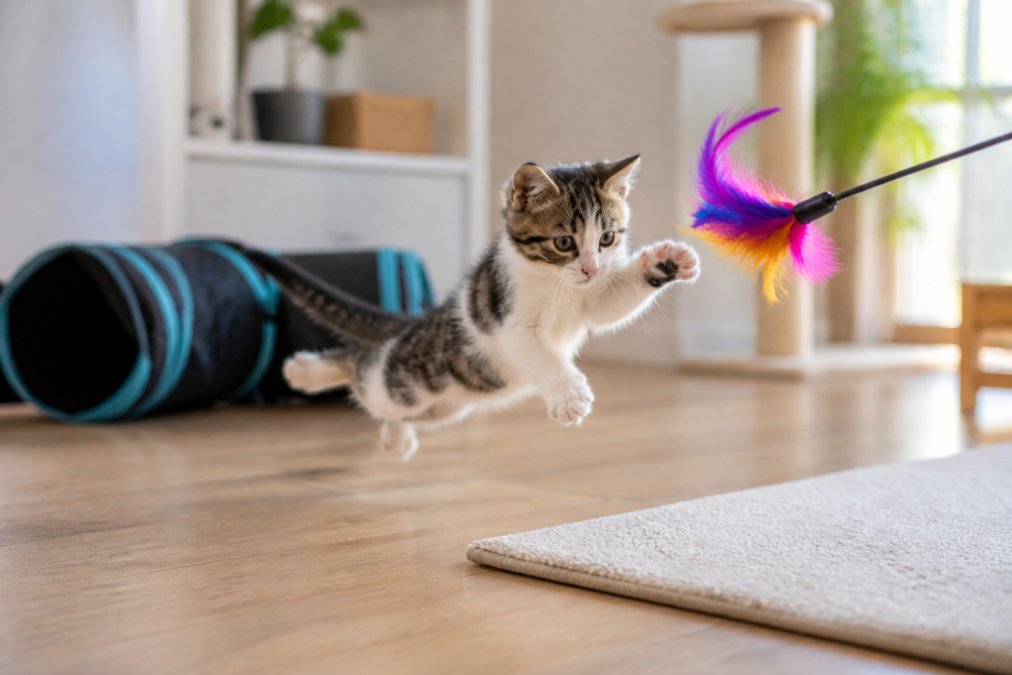
Wand and Feather Toys That Mimic Prey
Feather wands remain the gold standard. One comparative review of seven top-rated toys gave a feather wand a perfect 10/10 for engagement. The wand lets you control the "prey" in real time, which is why it holds a kitten's attention longer than anything battery-powered.
Electronic Toys for Solo Play
Electronic toys matter when you are not home. The SmartyKat Hot Pursuit, which hides a spinning wand under a fabric cover, earned strong marks in 2026 community testing for unpredictable prey-mimicking movement.
Best Puzzle Feeders for Cats That Need a Challenge
The best puzzle feeders for cats turn mealtime into a problem to solve. A 2026 expert review scored a Trixie Activity Board 9/10 for mental stimulation, and catnip-based food toys 9/10 as well. They tap into foraging, the drive that keeps a cat working for food in the wild.
The Foraging Progression: Start Easier Than You Think
Most owners quit puzzle feeders because they start too hard. Work through this progression instead:
- Scatter feeding. Toss a portion of kibble across a hard floor. The kitten walks, sniffs, and picks up one piece at a time, learning that food comes from searching, not from a bowl.
- Shallow compartment board. A tray with wide, open cups the kitten can paw into. No sliding, flipping, or lids.
- Sliding or flipping pieces. The Trixie Activity Board and similar multi-stage boards. The kitten must paw a piece aside.
- Rolling or tumbling feeders. A weighted ball that releases kibble as it rolls, adding movement that suits high-energy kittens who want to chase their food.
- Lidded and latching puzzles. The hardest tier. Reserve these for kittens who have solved tiers 2 through 4 without frustration.
DIY Puzzle Feeders That Cost Almost Nothing
You can build a full foraging rotation from things already in your home:
- Muffin tin + tennis balls. Drop a treat in each cup, cover each with a ball. The kitten lifts or nudges the ball aside. One of the easiest first puzzles, it works for kittens as young as three months.
- Cardboard tube puzzle. Tape three or four empty paper towel tubes to cardboard at slight angles, drop kibble inside, and let the kitten bat the food out. Replace when shredded.
- Plastic bottle roller. Punch a few holes slightly larger than a kibble in a clean, lid-on bottle. The kitten rolls it to release food. Check for sharp edges before every use and retire it the moment it cracks.
- Ice cube tray scatter. Freeze a portion of wet food or broth in an ice cube tray. The kitten licks and paws at the cubes as they thaw. A slow feeder and cooling enrichment tool in one.
Matching the Feeder to Your Kitten's Play Style
Watch how your kitten plays with a wand toy and pick the feeder that matches:
- Paw-ers who bat at everything do best with sliding and flipping boards.
- Chasers who sprint after the wand do best with rolling feeders they can pursue.
- Diggers who paw at the floor or litter do best with shallow compartment boards and snuffle-style mats.
- Lickers who groom and mouth everything do best with lick mats and frozen puzzles.
Troubleshooting a Kitten That Ignores the Puzzle
If your kitten walks away from a feeder, the problem is almost always difficulty, not disinterest. Try these fixes in order:
- Lower the difficulty. Move back one tier in the progression above.
- Add a scent trail. Rub a treat against the puzzle surface so the kitten smells food before it sees the mechanism.
- Prime the puzzle. Leave one piece of food visible at the entrance so the kitten gets an immediate reward.
- Shorten the session. Five minutes of success beats fifteen of failure. Put the puzzle away before the kitten gives up.
- Check the mechanism. A sticking slider or an overly heavy lid defeats a kitten every time. Test it with your own hand first.
How to Tire Out a Kitten in 15 Minutes a Day
You can tire out a kitten in 15 minutes by splitting play into short, intense sessions that follow the full hunt sequence: stalk, chase, pounce, catch. A 2026 Meowing Goods test of more than 15 toys across eight indoor cats found motion-activated and chase toys converted pent-up energy far better than simple jingle toys.
The Hunt Sequence, Step by Step
Every session should walk through four phases in order. Skipping one is the most common reason a kitten stays wired after play.
- Stalk. Move the wand slowly along the floor or behind furniture. Let the kitten crouch, lock eyes, and wiggle its rear. This phase can take a full minute; rushing it is a mistake.
- Chase. Flick the toy into a sprint. Let the kitten pursue it across the room. Change direction unpredictably, but stay within reach.
- Pounce. Let the kitten actually catch the toy. Pause movement the moment it lands. This is the reward.
- Catch and release. Let the kitten hold the toy a few seconds, then gently reset. Repeat two or three times per session.
A Simple Daily Play Schedule Template
| Time of Day | Activity | Duration | Toy Type |
|---|---|---|---|
| Early morning | Wand play, fast and erratic | 7 minutes | Feather wand |
| Midday | Puzzle feeder with part of lunch | 10 minutes | Activity board |
| Evening | Chase session, end with a catch | 8 minutes | Electronic or laser toy |
| Before bed | Lick mat or calm chewing | 10 minutes | Lick mat |
The evening session matters most. A kitten that catches something before bed is far less likely to attack your feet at midnight.
Reading Overstimulation Before It Becomes a Bite
High-energy kittens flip from playful to overstimulated fast. Watch for:
- Tail lashing. A fast, whipping tail is not excitement. It is a warning.
- Ears flattening or rotating back. The clearest early sign the kitten is done.
- Pupils dilating wide. A sudden pupil change during play means the kitten is switching from hunt mode to defense mode.
- Skin twitching along the back. Often called rippling, this precedes a swat or bite.
- Freezing mid-pounce. A kitten that stops moving is not bored. It is deciding whether to escalate.
Adapting the Routine to Your Kitten's Energy Level
Adjust the schedule based on what you see:
- The relentless kitten who never settles may need three short sessions instead of two, with the extra one mid-afternoon.
- The anxious kitten who startles easily does better with longer, slower stalk phases and quieter toys. Skip electronics until the kitten is comfortable with wand play.
- The solo kitten home alone all day benefits from a morning puzzle feeder and a longer evening session, because daytime energy has nowhere to go.
- The multi-cat household may need separate sessions. A high-energy kitten will monopolize a wand toy and leave the older cat watching, building frustration in both.
What to Do When 15 Minutes Is Not Enough
If your kitten is still bouncing off the walls after a full routine, the issue is usually intensity, not total play time. Try these adjustments before adding minutes:
- Increase the chase phase. A longer sprint burns more energy than a longer stalk.
- Add a second catch. Two or three catches per session instead of one.
- Stack activities. Pair a puzzle feeder with a wand session so the kitten works mentally and physically at once.
- Check the environment. A kitten with nothing to climb burns energy on your furniture. A cat tree near a window gives it a place to perch, watch, and self-entertain between sessions.
Age-Specific Safety Rules for Kitten Play
Safety rules change as a kitten grows. Kittens under four months have fragile, developing teeth and claws, so avoid toys with small parts that can detach. Check every toy for loose bells, glued-on eyes, or fraying string before each session.
Noise, Anxiety and Toy Rotation: What Most Guides Skip
Two things separate a toy that gets used from one that collects dust: noise level and novelty. A 2026 Guardian report noted experts increasingly recommend mixing catnip items and cardboard enrichment tools with interactive toys for a full sensory routine. Variety, not volume, holds attention.
Conclusion
The gap between a bored kitten and a settled one usually comes down to 15 minutes of structured play a day. The right indoor cat toys for high energy kittens mimic prey, reward the catch, and survive real teeth.
Frequently Asked Questions
What are the best toys for hyperactive kittens?
Toys that mimic prey movement work best. Experts who tested 65 cat toys in 2026 found that items which flutter, dart or slither spark the strongest response. A rotating laser with unpredictable patterns, a feather wand and a treat-dispensing puzzle feeder cover three different needs: chase, stalk and forage. Rotating among them keeps a hyperactive kitten engaged instead of bored after five minutes.
How often should you play with a high-energy kitten?
Two or three short sessions a day, roughly 10 to 15 minutes each, fits most high-energy kittens. A 2026 review of enrichment tools recommends combining wand toys, laser toys and puzzle feeders rather than relying on one type. End each session with a physical catch, such as a treat or a plush toy the kitten can grab, so the hunt has a finish.
Are laser pointers safe for indoor cat toys?
They are safe when used with a finish. A laser never lets a cat complete the hunt, and community discussions in 2026 note that this can cause frustration. Pair the laser with a treat or a tangible toy at the end of the session. An automatic laser with an auto-shutoff timer also prevents overstimulation and gives you a hands-free option for solo play.
Do puzzle feeders really help with kitten development?
They do. A 2026 review scored an activity board 9 out of 10 for mental stimulation, and the National Institutes of Health links environmental enrichment to indoor cat welfare. Foraging from a puzzle feeder or a lick mat slows eating, adds problem-solving and gives a kitten something to do between active play sessions. Introduce easy puzzles first, then increase difficulty as the kitten learns.
If your kitten is bouncing off the walls, the fix is rarely more toys. It is better toys, used with a plan. Lesara's Odds & Ends carries the tools that fit that plan: the Automatic Laser Cat Toy with its unpredictable rotating beam and auto-shutoff timer, and the Dog Lick Mat for cats that need to wind down after the hunt. Both ship free, and exchanges are hassle-free if your cat disagrees. Add to cart and give your kitten the hunt it is asking for.


