


Table of Contents
- Why Your Portable Steam Iron Needs Descaling
- What You'll Need Before You Start
- How to Descale a Portable Steam Iron: Step-by-Step
- Can You Use White Vinegar to Descale a Steamer
- How to Clean a Portable Steam Iron Between Descaling
- How Often to Descale a Steam Iron
- Troubleshooting Common Descaling Problems
- Frequently Asked Questions
Last Updated: October 10, 2026
Why Your Portable Steam Iron Needs Descaling
A portable steam iron heats water into steam that smooths wrinkles. Over time, minerals from tap water build up inside the tank and steam vents, and this limescale clogs the steam outlets and reduces performance.
As deposits accumulate, steam output weakens and you'll notice sputtering or water leakage instead of clean steam.
Descaling removes these deposits and restores full power, keeping your portable steam iron working smoothly for years in under 30 minutes.
What You'll Need Before You Start
Gather these items before you begin:
- Distilled water (essential, tap water contains minerals)
- White vinegar or a commercial descaling solution
- A small bowl or cup
- A cloth or old towel
- Your portable steam iron
- The manufacturer's instructions (check the manual for any restrictions)
Some people use citric acid, others prefer commercial descalers. Check your manual first, since some manufacturers void warranties if you use vinegar.
How to Descale a Portable Steam Iron: Step-by-Step
Descaling takes about 20-30 minutes. Follow these steps carefully to avoid damaging your iron.
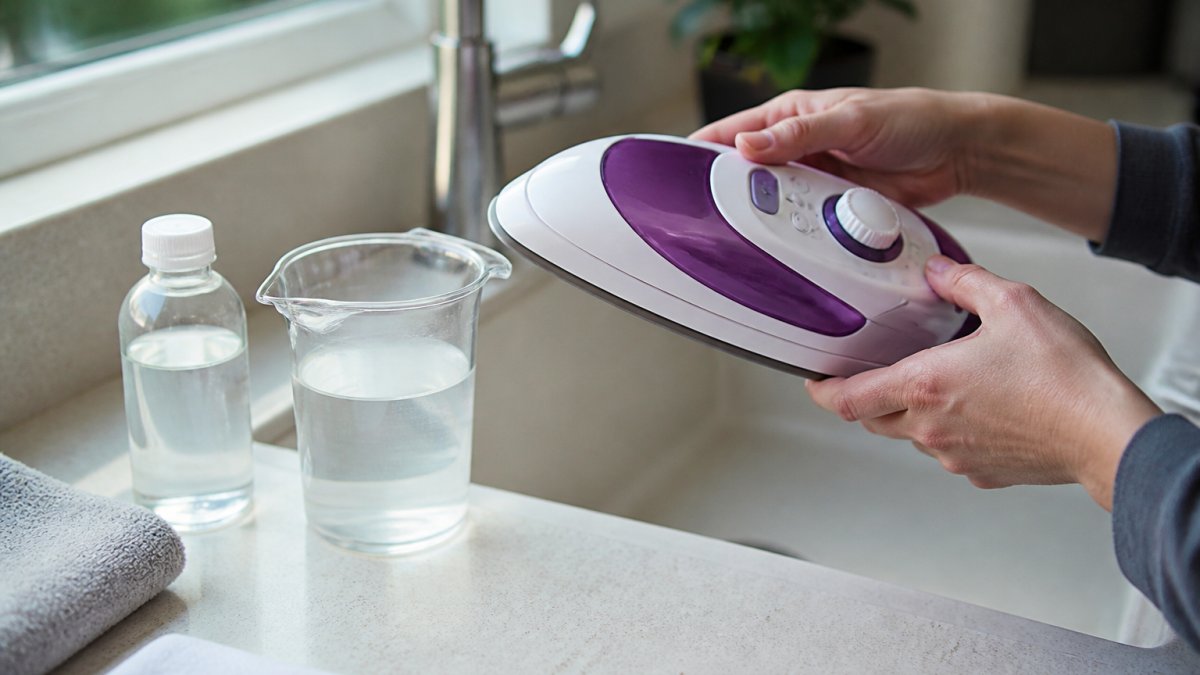
Step 1: Unplug and Cool Down
Always unplug your iron and let it cool for at least 15-20 minutes. Never work on a hot appliance, you risk burns and damage to internal parts.
Step 2: Empty the Water Tank
Remove any remaining water from the reservoir. Most portable irons have a drain plug or removable tank cap; check your manual. Hold the iron over a sink and open the drain, or pour water out through the fill opening if there's no drain plug.
Step 3: Fill with Cleaning Solution
Mix your descaling solution according to the instructions:
- White vinegar method: Mix 1 part white vinegar with 2 parts distilled water
- Commercial descaler: Follow the product's dilution ratio (usually 1 part descaler to 3-4 parts water)
- Citric acid method: Dissolve 1-2 tablespoons of citric acid in 1 cup of distilled water
Pour the solution into the tank until it's about three-quarters full, leaving room for it to expand as it heats.
Step 4: Heat and Release Steam
Plug in the iron and set it to the highest temperature setting (usually "Cotton" or "Steam"). Let it heat for 3-5 minutes.
Once heated, hold the iron over a sink or bowl and press the steam button in short bursts for about 2-3 minutes to release steam and cleaning solution through the vents. Discolored water or a vinegar smell means deposits are dissolving; keep pressing until the output runs clear and the smell fades.
Step 5: Rinse with Distilled Water
Empty any remaining solution and rinse the tank thoroughly, then refill with fresh distilled water only. Heat the iron again and release steam for 2-3 minutes to rinse out leftover solution. Repeat 2-3 times until the steam smells clean.
Can You Use White Vinegar to Descale a Steamer
Yes, diluted white vinegar can dissolve the calcium carbonate and magnesium deposits that clog a portable steam iron's tank, passages, and vents. The acetic acid breaks the scale into soluble compounds that flush out with rinse water. For many compact irons, a 1:2 vinegar-to-distilled-water mix restores steam flow.
But vinegar is not universally safe. A portable steam iron has a heated soleplate, a nonstick or ceramic coating, metal steam vents, and rubber or silicone gaskets, and acetic acid can degrade some of those materials over repeated exposure.
When vinegar is usually fine:
- The manual lists vinegar, acetic acid, or a DIY descaling solution as an approved method
- The tank and internal water path are stainless steel or uncoated plastic
- The soleplate is bare metal rather than a coated nonstick surface
- The iron is out of warranty or the maker does not restrict cleaning methods
When to skip vinegar:
- The manual says to use only the manufacturer's descaler or a specific product
- The soleplate has a ceramic, titanium, or nonstick coating that the maker warns against acids
- The iron is under warranty and the terms exclude damage from unauthorized cleaning agents
- You have already noticed gasket swelling, a loose tank seal, or residue around the fill port
Warranty reality check: Manufacturers can deny a claim if damage came from an unapproved cleaning agent. The manual is the deciding document; if it's silent, treat vinegar as a calculated risk.
Vinegar vs. citric acid vs. commercial descaler:
| Method | Typical mix | Strength | Best for | Watch out for |
|---|---|---|---|---|
| White vinegar | 1 part vinegar : 2 parts distilled water | Mild | Occasional maintenance on uncoated irons | Lingering odor; repeated use on coated soleplates |
| Citric acid | 1-2 tbsp per 1 cup distilled water | Moderate | Stubborn scale in stainless or plastic tanks | Can be more aggressive than vinegar on some seals |
| Commercial descaler | Follow label ratio | Formulated | Irons under warranty or with coated soleplates | Cost; must match the maker's approved chemistry |
Technicians typically start with the mildest method the manual allows and escalate only if steam output doesn't improve, protecting seals and coating while still removing scale.
Never run undiluted vinegar through a portable steam iron. Full-strength acetic acid can pit metal, soften gaskets, and strip coatings. Always dilute, and never leave the solution sitting in the tank overnight.
If you are unsure whether your iron tolerates vinegar, run a small test: mix the 1:2 solution, fill the tank only one-quarter full, heat the iron, and release steam for 30 seconds over a sink. If you see discolored or cloudy water, a chemical smell beyond vinegar, or any change in the soleplate surface, stop and switch to a commercial descaler approved for your model.
How to Clean a Portable Steam Iron Between Descaling
You don't need a full descaling every month. Simple maintenance between sessions keeps your iron in good shape.
Wipe the soleplate after each use:
- Let the iron cool for 10 minutes
- Wipe the bottom plate with a damp cloth
- Remove fabric residue and buildup before deposits harden
Use distilled water only in the tank:
- Tap water introduces minerals that build up over time
- This single habit cuts descaling frequency in half
Empty the tank after each use:
- Stagnant water develops odors and mineral deposits
- Drain completely and leave it open to dry
Store in a dry location:
- Keep your portable iron in a cool, dry place
- Humidity speeds up mineral buildup, so dry storage extends time between descaling
How Often to Descale a Steam Iron
There is no single correct interval. Descaling frequency depends on water hardness, usage, and build.
Start with water hardness. Hard water in the U.S. is generally more than 7 grains per gallon (about 120 mg/L) of dissolved calcium and magnesium.
Then factor in usage. An iron used twice a week accumulates scale slowly; the same iron used daily with tap water in a hard-water region can develop noticeable buildup in weeks.
| Water hardness | Light use (1-2x/week) | Moderate use (3-5x/week) | Daily use |
|---|---|---|---|
| Soft (<3.5 gpg) | Every 6-8 months | Every 4-6 months | Every 3-4 months |
| Moderately hard (3.5-7 gpg) | Every 4-6 months | Every 3-4 months | Every 2-3 months |
| Hard (7-10 gpg) | Every 3-4 months | Every 2-3 months | Every 6-8 weeks |
| Very hard (>10 gpg) | Every 2-3 months | Every 6-8 weeks | Every 4-6 weeks |
Switching to distilled water for every fill can stretch those intervals substantially, often doubling them, because you no longer add new minerals with each use.
Match the symptom to the cause before you descale. Not every performance problem is scale, and descaling unnecessarily wastes time and exposes seals to acid.
- Weak, uneven steam from some vents but not others, partial scale blockage in the affected vents. Descale, then flush at multiple angles.
- Sputtering and spitting water instead of steam, scale or mineral debris interfering with the heating chamber, or the iron is being used below its steam temperature. Confirm the temperature setting first, then descale.
- White or chalky residue on the soleplate, minerals carried up through the steam path and deposited on the hot plate. Descale and wipe the cooled soleplate with a damp cloth.
- Water leaking from the tank or around the fill cap, usually a failed gasket or cracked tank, not scale. Descaling will not fix it and may worsen a compromised seal.
- Brown or rust-colored discharge, internal corrosion or long-standing scale breaking loose. Descale, rinse thoroughly, and if the color persists after two rinse cycles, stop using the iron.
- No steam at all but the iron heats, a blocked steam path or a failed pump/valve. Descale once; if nothing changes, the issue is mechanical.
- Iron will not heat after descaling, residual solution or moisture in the heating circuit. Empty, rinse with distilled water, and dry the tank fully before retesting.
The safest schedule is the one your manual specifies, adjusted upward for hard water and heavy use. When in doubt, descale earlier rather than later, but never extend a soak beyond the time the manufacturer allows, and never leave descaling solution in the tank between sessions.
Troubleshooting Common Descaling Problems
Problem: Steam still comes out weak after descaling
The descaling solution may not have reached all the steam vents.
Problem: Vinegar smell lingers after rinsing
You didn't rinse thoroughly enough. Fill the tank with distilled water and repeat the steam release cycle 3-4 more times; the smell fades with each rinse.
Problem: Water leaks from the tank instead of steaming
Your iron may have a cracked internal seal or damaged tank. Stop using it and consult the manufacturer. Leaking can damage your clothes and indicates a serious problem that descaling won't fix.
Problem: The iron won't heat up after descaling
Make sure you completely emptied the cleaning solution and rinsed the tank thoroughly, since leftover vinegar or descaler can interfere with heating elements.
Problem: Descaling solution splashed on clothes
Rinse the affected area immediately with cold water. Most vinegar or descaler solutions wash out easily if treated quickly.
Descaling your portable steam iron keeps it working like new.
At Lesara's Odds & Ends, we understand that portable irons need reliable performance when you're on the go.
Frequently Asked Questions
How can I tell if my portable steam iron needs descaling?
Signs your portable steam iron needs descaling include weak or sputtering steam output, water leakage from the soleplate, mineral residue visible in the steam vents, or a musty odor when you first power it on. These symptoms indicate mineral deposits and limescale buildup inside the water tank and steam passages. If you use hard water regularly, expect to descale every 1-3 months. Distilled water reduces buildup but doesn't eliminate the need for periodic descaling.
Can you descale a steam iron with white vinegar?
White vinegar can dissolve mineral deposits in a portable steam iron, but results vary by model. Some manufacturers approve vinegar solutions; others recommend against them due to potential damage to internal components. Check your appliance's manual before using vinegar. If approved, dilute white vinegar with distilled water (1:1 ratio) and run it through the tank and steam vents over a cloth. Afterward, flush thoroughly with distilled water to remove vinegar residue and odor.
How often should you descale a portable steam iron?
Descale your portable steam iron every 1-3 months if you use hard water, or every 3-6 months if you use distilled water. Frequent travelers and heavy users may need to descale monthly. The exact interval depends on your water hardness and how often you use the iron. Check the water tank regularly for mineral buildup or white residue. If steam output weakens or sputtering occurs, descale immediately rather than waiting for your scheduled maintenance.
What should I do if my portable steam iron stops producing steam after descaling?
If steam stops after descaling, mineral deposits may still block steam vents or the heating element. Run additional cycles of distilled water through the iron to flush remaining residue. Heat the iron, hold it over a cloth, and press the steam button repeatedly for 30-60 seconds. If the problem persists, let the iron cool completely, then repeat the entire descaling process. Ensure you're using distilled water for rinsing, as tap water can reintroduce minerals. If the issue continues, consult the manufacturer's instructions or contact customer support.


