


Table of Contents
- What Makes a Retractable Leash Travel-Ready
- Tape vs. Cord: Which Mechanism Handles Travel Better
- Matching Leash Length and Weight Rating to Your Dog
- Brake Systems and Handle Ergonomics That Matter on the Road
- Retractable Leash Safety Tips for Unfamiliar Places
- How to Train a Dog on a Retractable Leash Before You Travel
- Travel Logistics: Packing, Weather, and Multi-Dog Management
- Frequently Asked Questions
Last Updated: September 17, 2026
What Makes a Retractable Leash Travel-Ready
A retractable leash is a leash with a spring-loaded housing that lets the line extend and retract as your dog moves, giving you adjustable length with one hand. For travel, the leash has to do more than work on your home block: it must pack flat, survive unfamiliar terrain, and stay controllable in crowds.
The American Kennel Club notes that retractable leashes can extend up to 30 feet, and standard lengths commonly sold include 10, 16, 26, and 32 feet (American Kennel Club guidance on retractable leash specifications). That range is exactly why travel changes the calculus. A 26-foot line is generous in an open field and a liability in a hotel lobby.
This guide from Lesara's Odds & Ends breaks down the four decisions that matter before you pack: mechanism, length and weight rating, brake and handle design, and safety protocol for unfamiliar places.
Tape vs. Cord: Which Mechanism Handles Travel Better
Tape wins for most traveling dogs. A tape leash uses a flat nylon ribbon; a cord leash uses a thin round line. Industry guidance suggests tape leashes provide more durability for bigger dogs than cord models (Electric-Collars.eu guidance on leash mechanism types).
Cord has real advantages: it's lighter, packs smaller, and slices through wet grass without collecting debris. Tape resists twisting, is easier to see, and won't cut into your hand during an emergency stop.
| Feature | Tape Leash | Cord Leash |
|---|---|---|
| Durability | Higher, better for large breeds | Lower, wears faster |
| Packability | Bulkier housing | Compact, light |
| Visibility | High, wide profile | Low, thin profile |
| Hand safety | Safer under sudden tension | Can cause rope burn |
| Best for | Dogs over 30 lbs, rough terrain | Small dogs, tight packing |
Pros of tape: durable, visible, safer grip. Cons: heavier, larger housing. Pros of cord: light, compact, cheap. Cons: wear-prone, hard to see, riskier under load.
For travel specifically, tape's durability and visibility outweigh the packing penalty. If you're flying with a carry-on only and a five-pound dog, cord is defensible.
Matching Leash Length and Weight Rating to Your Dog
Match length to environment and weight rating to your dog's actual weight, not its breed. Wirecutter recommends retractable leashes primarily for smaller, non-reactive dogs that aren't prone to heavy pulling (Wirecutter's Best Dog Leashes of 2026).
Length decisions by destination:
- Airport terminals and hotel corridors: 10 feet maximum
- Suburban sidewalks and rest stops: 16 feet
- Open parks and hiking trails: 26 feet
- Beaches and fenced fields: 32 feet
Weight rating is where owners get careless. Experts emphasize checking the specific weight rating printed on the packaging rather than guessing (The Kudi Pet guidance on leash weight ratings). A leash rated to 25 lbs will fail under a 60-lb dog that lunges.
Brake Systems and Handle Ergonomics That Matter on the Road
A locking brake system and an ergonomic handle are the two features you'll notice most on a trip. The brake is your only control point; the handle determines whether you can hold it for a two-hour layover.
Test the brake before you buy. A good locking mechanism engages with one thumb press, holds under tension, and releases without sticking. Spring tension should retract the line smoothly, not snap it back.
Dual Pet Leash Retractable Reflective →
Handle ergonomics matter more when traveling because you're often carrying something else. Look for a frosted or textured grip that stays secure in wet conditions, and a curved shape that reduces hand fatigue over long walks.
If you're managing two dogs, a dual-dog design solves a problem single leashes can't. The Dual Pet Leash Retractable Reflective Lead 360 Swivel Double Dog Walking Leash uses a 360-degree swivel mechanism to prevent tangling, a one-click safety lock for instant control, and a frosted curved handle for grip in wet conditions. It runs 10 feet per dog and is rated to 110 lbs per dog, with reflective strips and a built-in night light for low-light walking.

Retractable Leash Safety Tips for Unfamiliar Places
Retractable leash safety tips start with one rule: lock the leash short before you enter any enclosed or crowded space.
The baseline rules apply everywhere:
- Lock to 3-4 feet in lobbies, elevators, and vet clinics
- Never wrap the line around your hand or wrist
- Keep the brake thumb-ready, not resting on the button
- Check the clip and housing for cracks before each walk
- Avoid retractable leashes near traffic, bicycles, or other dogs on tight leads
Build a failure kit before you leave home:
- A backup slip lead. A six-foot slip lead weighs a few ounces and fits in a jacket pocket. If the retraction mechanism jams or the tape snaps, clip the housing to your belt, switch to the slip lead, and finish the walk under control.
- A spare carabiner. If the clip fails but the line and housing are intact, a carabiner lets you attach the line directly to your dog's collar or harness.
- Your leash's model number and weight rating, photographed. If the unit is beyond repair, you can replace it with an identical model instead of guessing at a pet store in an unfamiliar city.
- A short traffic handle. Many travel-oriented retractable leashes include a secondary handle near the clip. If yours does not, a 12-inch length of webbing looped through the clip gives you a close-control grip for crosswalks and crowded sidewalks.
The training community is genuinely divided on retractable leashes. Critics argue they can be dangerous or counterproductive for training, and some trainers label them a "no-no" for certain dogs (r/OpenDogTraining discussion on retractable leash use). That criticism is fair for reactive or heavy-pulling dogs. It is less relevant for a calm small dog in a controlled setting, but the failure protocol above applies regardless of your dog's temperament, because it is about the hardware, not the dog.
How to Train a Dog on a Retractable Leash Before You Travel
Training a dog on a retractable leash takes about two weeks of short daily sessions before it becomes reliable. Start at home, not at the airport.
- Days 1-3: Lock the leash at 4 feet and practice loose-leash walking in your yard.
- Days 4-6: Unlock to 10 feet, practice recall, and reward every check-in.
- Days 7-9: Practice the brake: lock, pause, release, reward.
- Days 10-12: Walk in a moderately busy area with the leash locked short.
- Days 13-14: Simulate travel: carry a bag, hold a coffee, and practice one-handed control.
Travel Logistics: Packing, Weather, and Multi-Dog Management
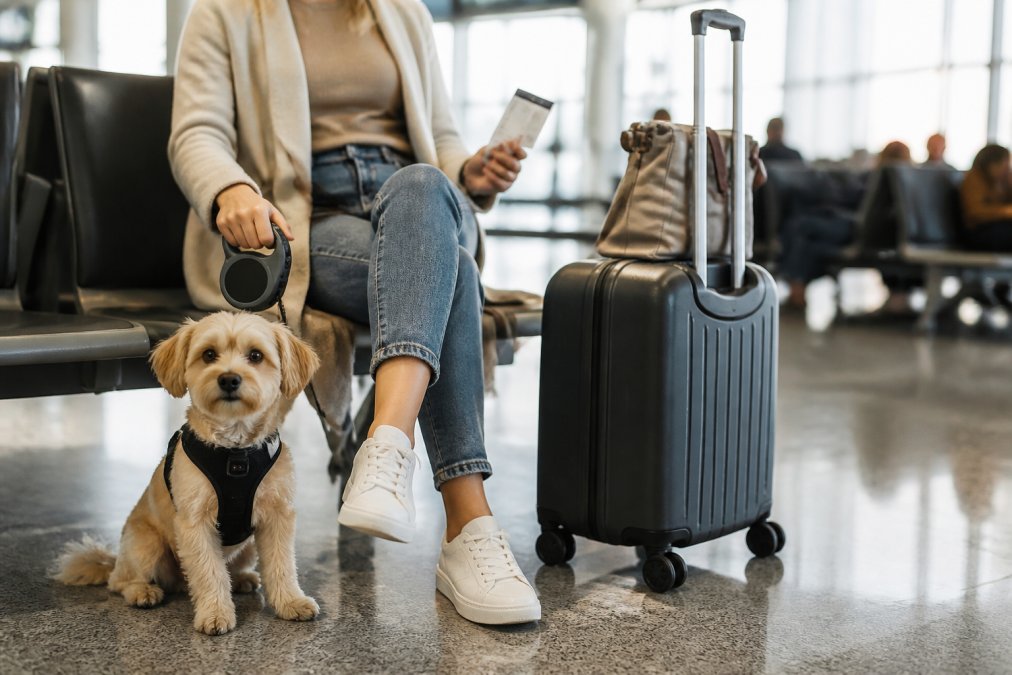
Packing a retractable leash is easy; managing it in transit is the hard part. Retract the line fully, engage the lock, and pack the housing where it won't get crushed. The spring mechanism is the fragile component, so do not bury the leash at the bottom of a checked bag under shoes and a laptop.
- Rain: Nylon tape gets slick and retraction slows. A tape leash with a coated or water-resistant ribbon sheds water better than bare nylon. Dry and re-spool the line before your next walk.
- Sand and beach: Fine sand works into the housing and grinds the spring. Rinse the housing exterior after beach walks and avoid dragging the line through wet sand.
- Snow and ice: Cold stiffens the spring and makes tape brittle. Let the leash warm to room temperature before extending it fully, and check for cracks in the housing after a cold-weather walk.
- Heat: Prolonged sun exposure degrades nylon over time. Store the leash out of direct sun in a hot car.
Frequently Asked Questions
Are retractable leashes safe for travel in crowded areas?
In crowded areas, keep the leash locked short so your dog stays close. Most retractable leashes extend up to 30 feet, which is too much slack in a busy terminal or market. Use the locking brake system to hold a 3 to 6 foot length, and watch for feet, strollers, and luggage. Retractable leashes suit smaller, non-reactive dogs that do not pull hard, so a crowded setting is workable only if your dog stays calm on a short lead.
What features should I look for in a travel-grade retractable leash?
Prioritize four things: a tape-style ribbon over cord for durability, an accurate weight rating printed on the packaging, a one-click locking brake system, and an ergonomic handle that stays comfortable on long walks. Reflective stitching and a built-in night light help in unfamiliar places after dark. A tangle-free 360-degree swivel also matters if you walk two dogs, since it prevents twists when they cross paths.
How do I determine the correct leash length for my dog's size?
Match length to environment and dog size. Standard retractable leash lengths are 10, 16, 26, and 32 feet. For travel, a 10 foot leash gives control in hotels, airports, and narrow streets, while 16 to 26 feet works for open parks and hiking trails. Smaller dogs do better with shorter lengths because the extra slack is hard to manage. Always check the weight capacity on the label rather than guessing.
How can I keep a retractable leash working well through long-term travel?
Clean the ribbon and housing after trips through sand, mud, or rain, since grit wears down the retraction spring. Check the clip and the brake button before each walk, and store the leash fully retracted so spring tension stays even. Tape-style leashes hold up better than cord models for larger breeds. If the brake slips or the ribbon frays, replace the leash instead of relying on it far from home.


