


Table of Contents
- What Makes a Portable Steam Iron Worth Packing
- Quick Comparison: Key Specs at a Glance
- Dual Voltage Travel Iron: Why It Matters for International Trips
- Heat-Up Time, Steam Output, and Water Tank Capacity
- How to Remove Wrinkles From Clothes Without an Iron
- Fabric-Specific Steaming: What's Safe and What Isn't
- Hotel Room Realities: Steamers vs. Irons on the Road
- Maintenance, Descaling, and Making It Last
- Frequently Asked Questions
Last Updated: September 12, 2026
What Makes a Portable Steam Iron Worth Packing
A portable steam iron is a compact garment care tool that combines a heated soleplate with a steam spray function, designed to fit in a carry-on and run on standard hotel power. For business travelers, the value is arriving at a meeting in a pressed shirt without hunting down the hotel's shared ironing board at 6 a.m.
Hotel irons scorch delicate fabrics, shared boards are often stained, and laundry service rarely returns clothes before your first meeting. A dedicated travel iron solves all three in about the footprint of a paperback.
This guide breaks down what matters when comparing options: voltage compatibility, heat-up time, tank capacity, and fabric safety, plus the hotel-room realities nobody mentions in the product photos.
Quick Comparison: Key Specs at a Glance
Here's how the core specs stack up across typical portable steam iron categories. Use this as a filter, not a ranking.
| Feature | What to Look For | Why It Matters |
|---|---|---|
| Voltage | Dual voltage (100-240V) | Works abroad without a converter |
| Heat-up time | Under 60 seconds | Usable between meetings |
| Tank capacity | 50ML or larger | Covers 1-2 garments per fill |
| Steam output | Continuous, not burst-only | Consistent wrinkle removal |
| Weight | Under 450 g | Stays carry-on friendly |
| Safety | Auto-shutoff | Protects hotel surfaces |
The specs that matter most depend on your trip type: a domestic weekend needs far less than a two-week international rotation.
Dual Voltage Travel Iron: Why It Matters for International Trips
A dual voltage travel iron runs on both 120V and 240V power, switching automatically or via a selector (energy.gov). Without it, a US-bought iron plugged into a European outlet will trip the breaker or burn out its heating element.
This is the most common mistake travelers make: they buy a cheap travel iron at home, pack it overseas, and discover on night one that it's useless.
Checking the Voltage Label Before You Buy
Look for a label reading "100-240V" or "AC 110-240V." If it only says "120V," it's domestic-only. Some models have a physical switch; others convert internally.
A plug adapter changes the shape of the prongs, not the voltage. That distinction trips up more travelers than any other. For official guidance on electrical safety and plug types, the U.S. Department of Energy appliance guidance is a useful reference.
Heat-Up Time, Steam Output, and Water Tank Capacity
Heat-up time determines whether a travel iron is usable on a tight schedule. Most portable models reach working temperature in 30 to 90 seconds, driven by three variables: wattage, soleplate mass, and whether the unit uses a flash boiler or a heated reservoir.
- Wattage (600W-1,200W typical). Higher wattage heats faster, but it also draws more current. A 1,200W iron on a 120V circuit pulls roughly 10 amps, fine on a dedicated hotel outlet, risky on a shared power strip with a laptop charger and a hair dryer.
- Soleplate mass. A thin aluminum soleplate reaches temperature in under 45 seconds but loses heat the moment it touches damp fabric. A thicker ceramic or stainless plate takes 60-90 seconds but holds temperature through a full shirt.
- Flash boiler vs. reservoir. Flash-boiler designs (common in handheld steamers) generate steam on demand in 20-30 seconds. Reservoir designs take longer to build pressure but deliver a steadier stream.
Steam output matters more than raw heat for wrinkle removal. A continuous 15-20 g/min stream penetrates fibers more consistently than a 30 g/min burst that sputters and stops; burst-only sprayers look impressive in demos but leave half the shirt creased.
How Long a 50ML Tank Actually Lasts
A 50ML water tank typically covers one to two medium garments, a dress shirt and trousers, before a refill. Heavier fabrics like wool or linen may consume the full tank on a single item.
At a 15 g/min continuous steam rate, 50ML lasts about three minutes of active steaming, enough for one dress shirt, or two if you're touching up collars and cuffs only. A 100ML tank doubles that window but adds 3-4 ounces and a bulkier housing.
Smaller tanks mean more refills, expect to refill daily on a week-long trip, but they keep the unit lightweight and leak-proof when packed, since there's less water to slosh against the seals.
Reading the Spec Sheet Without Getting Fooled
Three numbers on a product page are worth trusting; three are marketing filler.
Trust these: wattage, tank volume in ML, and heat-up time in seconds when the brand publishes a tested figure.
Discount these: "professional-grade steam," "wrinkle-free in one pass," and any g/min rating without a stated test method. Budget listings often quote peak burst output rather than sustained output, the number looks twice as high as the continuous rate you'll actually use.
If a listing doesn't publish wattage or tank volume, the unit is built to a price, not a spec. For one outfit per day, a 700W-900W unit with a 50-60ML tank and a published heat-up time under 60 seconds is the sweet spot.
How to Remove Wrinkles From Clothes Without an Iron
Knowing how to remove wrinkles from clothes without an iron is a survival skill for any traveler, whether your steamer dies, your hotel lacks one, or you're stuck without power.
- Hang in the bathroom during a hot shower. Steam from the shower relaxes fibers in 10-15 minutes. Works well on knits and light cottons.
- Use a wrinkle-release spray. A mix of water and a small amount of fabric conditioner in a spray bottle relaxes creases when you smooth the fabric by hand.
- Roll, don't fold. Rolling garments tightly in a suitcase creates fewer hard creases than folding.
- Pack a dryer sheet. Tossing one in the dryer with a wrinkled item for a few minutes works, but hotel dryers are hit or miss.
- Weigh down the hem. Hang the garment and clip small weights to the bottom hem; gravity does the rest overnight.
These methods buy time, but none match a proper steamer for a dress shirt before a client meeting. For deeper background on fabric care, the American Cleaning Institute's fabric care resources covers fiber-specific guidance.
Fabric-Specific Steaming: What's Safe and What Isn't
Not every fabric tolerates direct steam. This is where cheap travel irons cause real damage, and it's the gap most buying guides ignore.
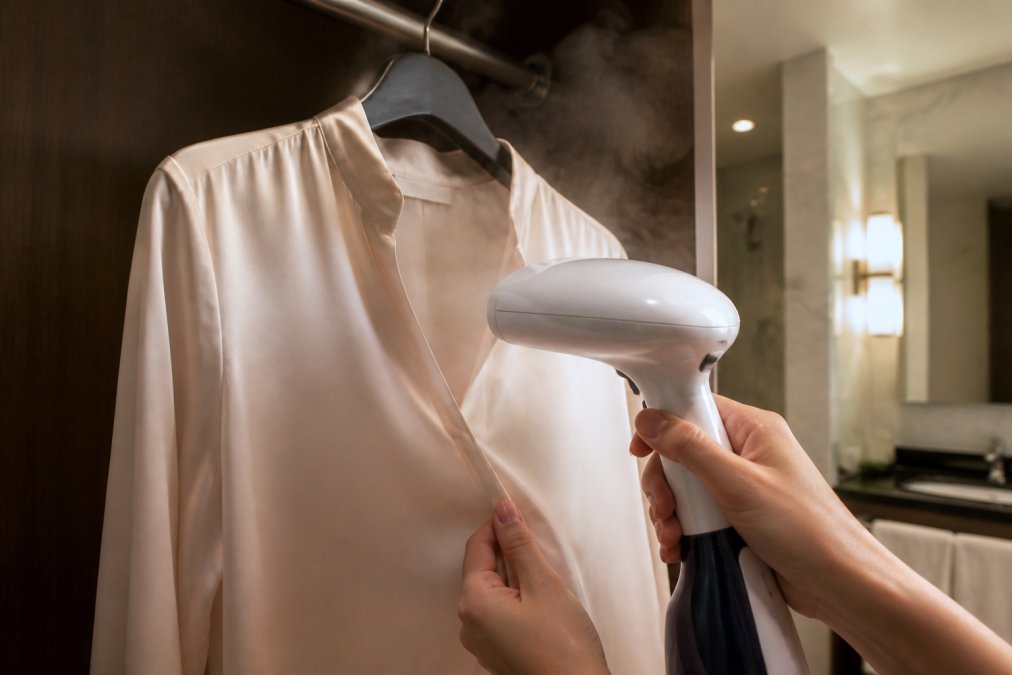
Safe for direct steam: cotton, linen, wool (with care), polyester blends, and most synthetics. Hold the steamer a few centimeters away and let the steam work.
Use caution with silk, rayon, and anything labeled "dry clean only": steam from a distance or test an inside seam first. Delicate fabrics scorch fast, and burn marks don't come out.
Never steam: leather, suede, waxed cotton, or garments with glued-on embellishments. Heat loosens adhesives and warps the material.
The dual temperature settings on a well-designed portable steam iron matter here. A low setting for delicates and a higher setting for cotton or linen gives you room to work without risking your expensive work blouses.
Hotel Room Realities: Steamers vs. Irons on the Road
Hotel rooms impose constraints product listings ignore: rarely a full-size ironing board, awkwardly placed outlets, limited counter space. Most buying guides test on a home board, not a closet rod next to a minibar.
Cord Length and Outlet Placement
Cord length is the most under-specified spec in the category. A 6-foot cord is standard; a 9-foot cord is rare and worth paying for. In most hotel rooms, the only outlet near a hanging rod is behind the TV or beside the bathroom mirror, forcing you to steam on the bathroom counter or drape the cord across a walkway.
A practical workaround: unplug the bedside lamp and use that outlet, it's usually within reach of the closet door. If the cord still won't reach, steam in the bathroom with the door closed and the exhaust fan running; the humidity relaxes fibers and the tile floor is a safe resting surface for a hot iron.
Hanger vs. Flat Surface: Which Technique Actually Works
Steamers are designed for vertical use: gravity pulls the fabric taut while steam relaxes the fibers. Hang the item, grip the bottom hem with one hand, and pull gently downward as you pass the steamer head top to bottom in overlapping vertical strokes, not circles.
Irons are designed for horizontal use. A shirt steamed on a hanger looks 80% pressed; pressed flat on a board it looks 100%, because the soleplate applies direct pressure steam can't replicate. For a client presentation, the flat-surface method still wins for collars, cuffs, and plackets.
A hybrid approach: steam the body on the hanger, then lay it flat on a folded towel on the bathroom counter to press the collar and cuffs with the iron function, most of a board finish without a board.
What Hotels Actually Provide (and What They Don't)
- Ironing board: Present in most mid-tier and upscale rooms, but often a wall-mounted fold-out too small for a full shirt.
- Iron: Usually a full-size unit bolted to the board. These run hot and are frequently scaled from tap water, the leading cause of brown streaks on white shirts.
- Steamer: Rare outside higher-end properties; when present, usually a shared unit from the front desk, which means waiting.
- Hair dryer: Not a substitute, the heat is too diffuse and the airflow too weak to relax woven fibers.
Why Steamers Win on the Road (and Where They Don't)
Steamers win on three counts: they work on hanging garments, so you don't need a board; they're gentler on fabrics, which matters when steaming the same blazer five days running; and they double as a freshener, removing odors and light creases without a full wash.
Irons still win for one thing: sharp creases in dress trousers. If your job requires a hard crease down a pant leg, a steamer alone won't deliver it, which is why an iron-and-steamer combo earns its place in a carry-on for anyone in a formal dress code.
Maintenance, Descaling, and Making It Last
A neglected portable steam iron will clog, sputter, and eventually stop steaming. The maintenance routine is simple, but skipping it shortens the unit's life dramatically.
- Empty the water tank after every use; never store it full
- Use distilled water to prevent mineral buildup
- Descale monthly with a vinegar-and-water solution if you use tap water
- Wipe the soleplate with a damp cloth once it's fully cool
- Check the cord for fraying before each trip
- Store folded, not compressed, to protect the steam nozzle
Descaling is the step most people skip. A clogged heating element is the top reason travel steamers fail, and it's almost always preventable.
Travel steamers aren't designed for user-serviceable parts, so treat them as a replaceable tool rather than a lifetime purchase, buying a slightly better unit upfront beats replacing a cheap one every year. My Store offers a lightweight, foldable portable steam iron with dual temperature settings and a 50ML tank, backed by free shipping and hassle-free exchanges, so you can test it on your next trip without risk.
Frequently Asked Questions
What should I look for in a portable steam iron for travel?
Prioritize three specs: dual voltage (100-240V) so it works overseas, a heat-up time under 60 seconds, and a water tank capacity around 50ML for one to two garments per fill. Check for auto-shutoff, a leak-proof design, and a cord at least 1.8 metres long. A foldable handle helps if you're packing in a carry-on with limited space. Fabric-specific temperature settings matter if you travel with silk, wool, or synthetic blends.
Can you take a portable steam iron on a plane?
Yes, in carry-on or checked baggage, but the rules differ. The TSA allows travel irons and garment steamers in carry-on bags since they are not lithium-battery devices. Empty the water tank completely before packing to avoid leaks and secondary screening. If your steamer has a removable lithium battery, it must go in carry-on only. Check with your airline for any additional restrictions on heating appliances.
Do portable steam irons work on all fabric types?
No. Most work well on cotton, linen, polyester, and blends. Delicate fabrics like silk, satin, and rayon need a low heat setting and should be steamed from a distance rather than pressed directly. Never use a steam iron on leather, suede, or waxed jackets. Always test on a hidden seam first. Dual temperature settings give you more control, but check the care label before steaming anything expensive.
How do I remove wrinkles from clothes without an iron while traveling?
Hang the garment in the bathroom, run a hot shower for five minutes, and let steam relax the fibers. For faster results, use a handheld steamer with vertical steaming. You can also roll clothes tightly and pack them last, or spritz with a wrinkle-release spray. If you have no steamer, lay the garment flat under a heavy suitcase for 20 minutes. These methods work best on cotton and blends, less so on stiff linen.
The challenge with any travel garment care tool is that it has to work in unfamiliar rooms, on unfamiliar fabrics, with no margin for error. Lesara's Odds & Ends built its portable steam iron around exactly those constraints: a lightweight, foldable design that fits a carry-on, dual temperature settings for different fabrics, and a steam spray function with a 50ML tank that handles a day's worth of garments. Add to cart and pack lighter on your next trip.


